

Initiative · Story to Screen
Screen Sisters brings the story. We put it on a unit.
Story to Screen is run jointly by Futures in Film CIC and Screen Sisters CIC. Two organisations, two boards, two sets of accounts, one programme.
Their half is the story: whose it is, how it is developed, and the cultural safety around telling it. Our half is everything after that — the crew, the equipment, the stages, the technical base, and the people earning a first credit by crewing it.
The division of labour
Two organisations, and it matters which one you are talking to.
A joint programme is easy to describe loosely and expensive to describe loosely. This is the line, drawn the same way on both sides.
| Screen Sisters CIC | Futures in Film CIC | |
|---|---|---|
| Company | Community interest company 16185639 | Community interest company 14621615 |
| Brings to the Lab | The writers, the network, the participants, and the cultural safety work. Stories from faith communities and backgrounds the industry has under-served. | The production simulation method, working practitioners, the equipment, the stages and the route from a finished script into a working unit. |
| Owns the relationship with | The writer and the story | The unit, the crew and the kit |
| Answers to | Its own board and the CIC Regulator | Its own board and the CIC Regulator |
| Does not | Speak for Futures in Film, or bank our money | Speak for Screen Sisters, or bank Screen Sisters’ money |
What we put behind it
A developed script still has to be shot by somebody.
Development gets a story to the point where it could be made. Everything in this list is what it takes to actually make it, and it is the half Futures in Film carries.
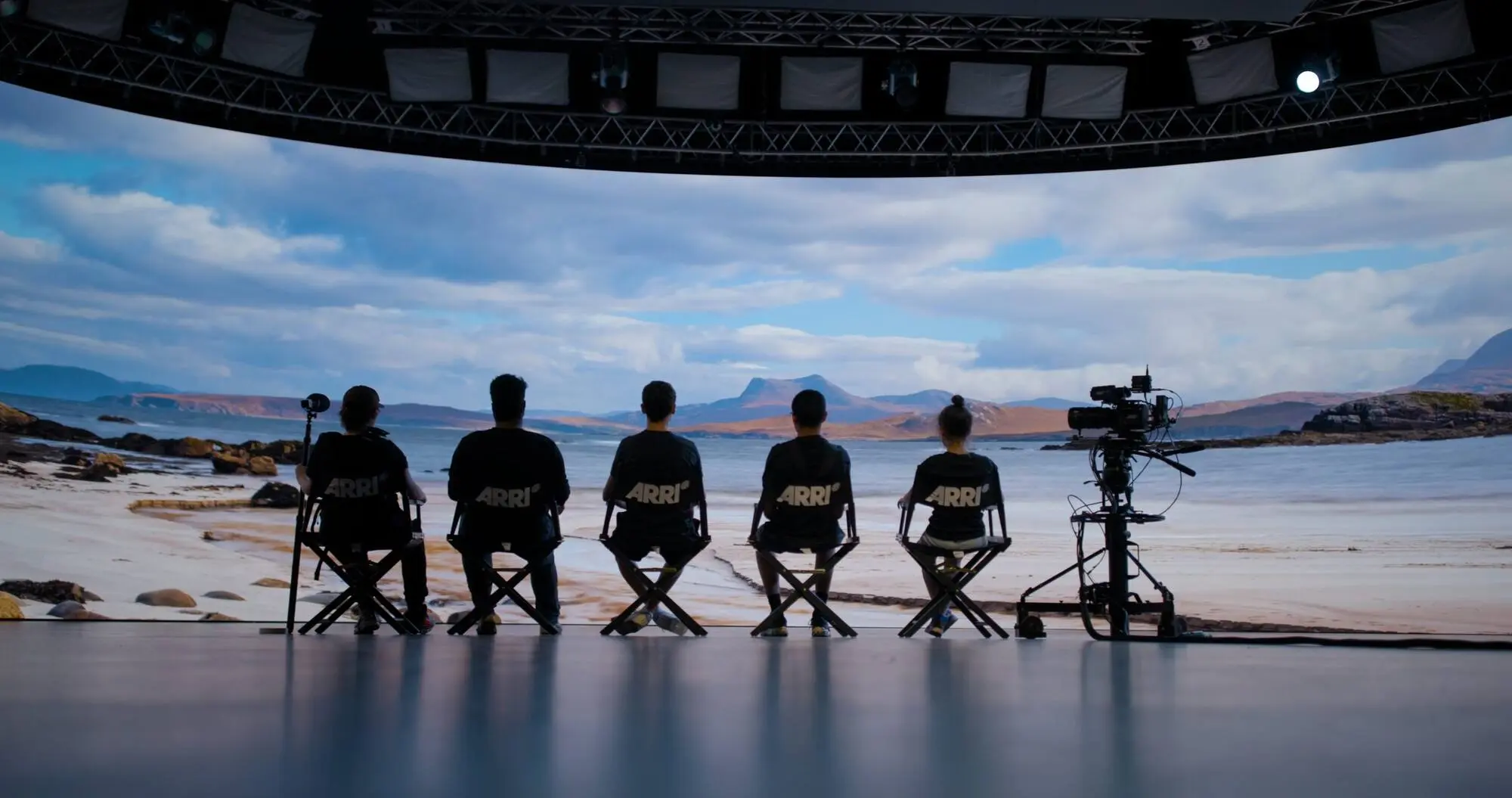
A working unit
Full crew positions with call sheets, grades and consequences — run as a production, not as an exercise.
Camera, lighting, grip and sound
Current equipment, prepped and checked, rather than equipment retired into a classroom.
The technical base
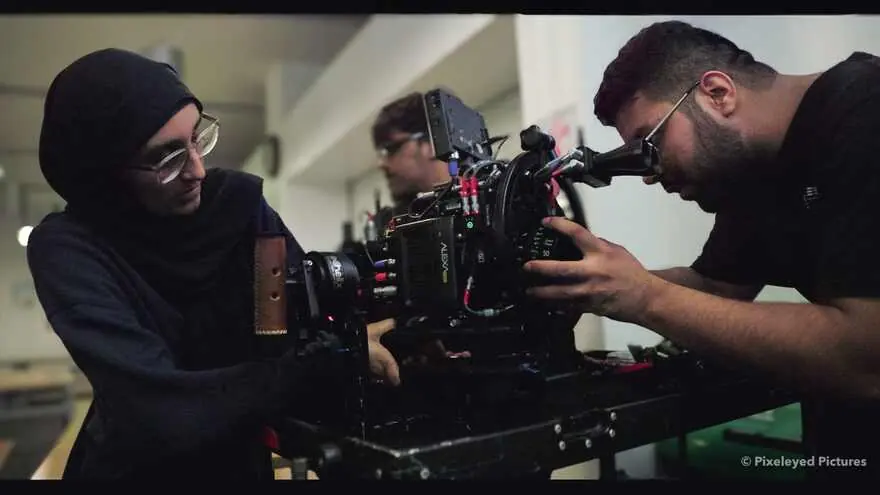
The Ken Adam Building at Pinewood Studios. Test rooms, prep space and the bench where a package gets built and checked.
Stages and locations
Pinewood and 3 Mills Studios. Somebody who starts at 3 Mills comes to Pinewood for the technical work.
Practitioners who are working now
The people teaching are on units this year. That is the difference between a course and a crew.
Post and delivery
The route from card to cutting room, and what a master has to clear to be accepted.
The part nobody else funds
Every Lab film is crewed by people earning a first credit.
This is the reason Futures in Film is in the programme at all. A Lab production is a real shoot with a real deliverable, and it is also the only place a new entrant can hold a grade on a unit with a supervisor beside them and a credit at the end.
One piece of work does two jobs. The story gets made, and the people who make it get the thing the industry actually asks for.
The stages
Submission, development, the writers room, commission.
Development runs on the Screen Sisters side. Where our half begins is the point a script becomes a shoot.
Run jointly with Screen Sisters CIC.
01
Submission
An idea, a treatment or a draft, with a short statement of why it has to be this story.
02
Development
Work on the material with a mentor: what it is about, and what is stopping it being makeable.
03
The writers room
Writers in a room together, working on each other’s material as well as their own.
04
Commission
Where a project is selected, it is commissioned and made, with trainees holding grades on it.
For funders
What you are funding depends on which door you came through.
Both organisations raise separately, bank separately and report separately. Nothing is double-counted, and neither of us can accept money on the other’s behalf.
| If you fund | At Screen Sisters CIC | At Futures in Film CIC |
|---|---|---|
| You are paying for | A story that is not being told reaching development, with the writer supported through it | The production capability that turns a developed script into a finished film, and the trainees who crew it |
| The outcome you can report | Writers developed, stories taken to a commissionable state, communities reached | Supervised trainee positions filled, technical training delivered, a film delivered to standard |
| Against a social value framework | Community and inclusion outcomes | PPN 026 skills outcomes — training and retraining, in-work progression, talent pipeline |
Support to this programme is taken in kind as readily as in cash — equipment, stock, facility time, or a supervised position on a unit. Terms are agreed with each project in writing.
A Gothic hall lit for an event
Bringing a story
If you have the story rather than the crew, start with Screen Sisters.
The front door for a writer is theirs, not ours. You do not have to be a filmmaker, and you do not have to intend to make it yourself — that is their invitation and it is the right one.
- Story to Screen is in development. Nothing is open for applications yet, on either side.
- Registering interest with us is not an application and gives us no rights in your idea.
- Mentors give notes and time. They do not decide what gets made.
- Neither organisation speaks for the other. If the question is about your story, it is a Screen Sisters question.
Who it is for
Writers and filmmakers with a real subject.
Open to people over 18 in the UK. Prior credits are not required. Priority goes to filmmakers from the communities the work is about, to women of faith, to people outside London, and to Deaf, Disabled and Neurodivergent writers.
Next
Two organisations, one programme, and a clear line between them.
If you are a funder, a commissioner or a supplier, the conversation about delivery is ours. If it is about a story, it is theirs. We will say so rather than take a meeting that belongs to them.