

Glossary
What people are saying, and what they mean.
Nobody explains the language on a set. They assume you have it, and if you have not, you spend your first week guessing and nodding. This is the page that stops that.
UK usage, UK grades. Where a job has an informal name and a formal one they are paired on first use — clapper loader and 2nd AC, focus puller and 1st AC, best boy and gaffer’s second, spark and electrician. Open an area below.
Area 01On the floor
| Term | What it means |
|---|---|
| Recce | A visit to a location before the shoot to decide how it will be shot and what has to be brought. Never called a scout here. |
| Unit base | The trucks, trailers and catering, parked away from the set. Where crew eat, change and get paid. |
| Call time | The time you are due on set, not the time you leave the house. On time is early. |
| First positions | Where cast and camera start a take. Called before every rehearsal and take. |
| Turnaround | The rest period between wrap and the next day’s call. Breaking it costs money and is a union matter. |
| Block, light, rehearse, shoot | The order a scene is built: work out the moves, light it, rehearse it, then shoot it. |
| Lock it up | Stop all movement and noise around the set so a take can run. Usually the AD department, loudly. |
| Crossing | Called when you have to walk in front of a lens or a light, so nobody is surprised. |
| Turning around | Repositioning the camera to shoot the other side of a scene. Always longer than anyone allowed for. |
| Hot set | A set that has been shot and must not be touched, because tomorrow has to match. |
| Standby | The art, costume and hair and make-up crew who stay on the floor through shooting to fix, dress and touch up between takes — standby props, standby art director, standby costume. Also: ready. |
| Company move | Moving the entire unit to another location inside a shooting day. Expensive, and it eats hours. |
| Magic hour | The short window after sunrise or before sunset when the light is low and warm. Twenty minutes, not an hour. |
| Abby | The second-to-last shot of the day. Named after Abby Singer, an American AD who called it reliably. |
| Martini | The last shot of the day, because the next one is in a glass. |
| Checking the gate | Inspecting the film gate for hairs before the camera moves on. On digital, playing back the last take. |
| Wrap | The end of the shooting day, or the end of the production. Wrapped on a person means they can go. |
| Sides | The pages being shot that day, printed small enough to live in a back pocket. |
| Going again | Another take, usually with a reason attached. If no reason is given, ask afterwards, not during. |
Area 02Camera
| Term | What it means |
|---|---|
| DoP | Director of photography. Responsible for the image: lighting, lensing and how the film looks. Never DP in the UK. |
| Focus puller / 1st AC | Keeps a moving subject sharp, builds the camera, and is responsible for the lenses. |
| Clapper loader / 2nd AC | Loads the camera, runs the slate, writes the camera report and looks after stock or cards. |
| DIT | Digital imaging technician. Handles data off the camera, the on-set look, and what post receives. |
| Camera report | The record of what was shot on each roll or card: takes, lenses, stop, and notes for post. |
| Slate | The clapperboard and the information on it — production, scene, take, roll, date, sound roll. |
| Tail slate | Slating at the end of a take instead of the start, when clapping at the front would break the moment. |
| Marks | Tape on the floor showing where a performer stops, so focus and framing hold. |
| Eyeline | Where a performer is looking. Get it wrong and the scene falls apart in the cut. |
| Stop | The aperture setting, and the unit for how much light you gain or lose. |
| Prime and zoom | A prime is a single focal length; a zoom covers a range. Primes are usually faster and sharper. |
| Mag | A magazine of film stock. On 35mm a 400ft mag runs roughly four and a half minutes. |
| Short end | Unexposed film left on a roll, kept and used for short takes rather than thrown away. |
| MOS | A take shot deliberately without sound. Everything else is sync sound. |
| Frame rate | Frames per second. Usually 24 or 25 for UK drama; higher when you want slow motion. |
| Filtration | Glass in front of or behind the lens to change contrast, diffusion or colour. |
| Steadicam | A body-mounted stabilised rig, operated by a specialist who is not doing anybody else’s job that day. |
| Rushes / dailies | The material shot that day, viewed once it has been processed or transcoded. |
Area 03Lighting and electrical
| Term | What it means |
|---|---|
| Gaffer | Head of the lighting and electrical department. Turns what the DoP wants into a rig that works. |
| Best boy / gaffer’s second | Second in the lighting department. Runs the crew, the kit and the paperwork. |
| Spark / electrician | The crew who rig, run and operate the lighting. Spark is the job, not a nickname for it. |
| Genny operator | Runs the generator and the power everything else depends on. |
| Distro | Distribution. The cable and boxes that get power from the generator to the lamps safely. |
| Practical | A light that appears in the shot: a table lamp, a screen, a candle. |
| Bounce and negative fill | Adding light by reflecting it, and taking light away by putting black next to it. |
| Colour temperature | How warm or cool a source is, in kelvin. Tungsten around 3200K, daylight around 5600K. |
| Flag / cutter | Solid black used to shape light and keep it off the things it should not be on. |
| Pre-rig and derig | Rigging lighting and grip before the unit arrives and stripping it after, usually by a separate rigging crew. |
Area 04Grip and rigging
| Term | What it means |
|---|---|
| Key grip | Head of the grip department. Responsible for camera support and every camera move. |
| Dolly grip | Operates the dolly or crane so a move lands exactly on the frame the operator wants. |
| Track | The rails a dolly runs on, laid and levelled by grips. Level matters more than speed. |
| Remote head | A motorised head on a crane or arm, operated from the ground rather than by an operator on the arm. |
| Rigging | Building the structures that cameras and lamps hang from. A separate discipline from the floor crew. |
Area 05Sound
| Term | What it means |
|---|---|
| Production sound mixer | Records the sound on set and is responsible for what the cutting room receives. |
| Boom operator | Places the microphone on a pole, out of frame and out of the light, for hours. |
| Radio mic | A concealed microphone on a performer. Prone to clothing rustle, and to being left on. |
| Speed | Called by sound once the recorder is running — after “turn over”, before “mark it”. |
| Sound report | The record of what was recorded, roll by roll, with notes for post. |
| Wild track | Sound recorded without picture: an effect, an extra line, a bit of atmosphere. |
| Room tone | A minute of the room doing nothing, so the editor can fill gaps invisibly. Always worth the minute. |
Area 06Production paperwork
| Term | What it means |
|---|---|
| Call sheet | The document that runs the day: call times, scenes, location, weather, nearest hospital, contacts. Issued the night before. |
| Movement order | How the unit and its vehicles get to a location: routes, parking, and what the neighbours have been told. |
| Stripboard | The shooting order, arranged by location, cast and daylight rather than by the story. |
| Day out of days | A chart of which cast member works on which day. It drives the budget more than the schedule does. |
| Risk assessment | A written record of the hazards and what has been done about them, signed by people who mean it. |
| Progress report | What was shot, how much of it, and how far ahead or behind the day finished. |
| Continuity notes | The script supervisor’s record of what matched, what did not, and what the editor will need. |
| Deal memo | The short written agreement setting your rate, dates and terms. Get one before you start. |
| Purchase order | Authorisation to spend money before you spend it, not after. |
| Crew list | Who is on the production, in which department, with contact details. The most useful document you will be given. |
Area 07Post and delivery
| Term | What it means |
|---|---|
| Offline and online | The offline is the creative edit at low resolution. The online rebuilds it at full quality. |
| Conform | Reassembling the finished edit from the original camera material at full resolution. |
| Grade | Colour grading. Setting the look shot by shot in a suite, with a colourist. |
| LUT | A look-up table: a colour transform used to preview a look on set and carry the intent to post. |
| ADR | Dialogue recorded after the shoot to replace or add a line. |
| Foley | Footsteps, cloth and handling sounds, performed to picture in a studio. |
| M&E | The music and effects mix, without dialogue. Required for any foreign-language version. |
| QC | Quality control. The technical check a master must pass before a broadcaster or distributor accepts it. |
| Delivery spec | The document listing every file, format and version the buyer requires. Longer than you expect. |
| Audio description | A spoken track describing what happens on screen, for blind and partially sighted audiences. |
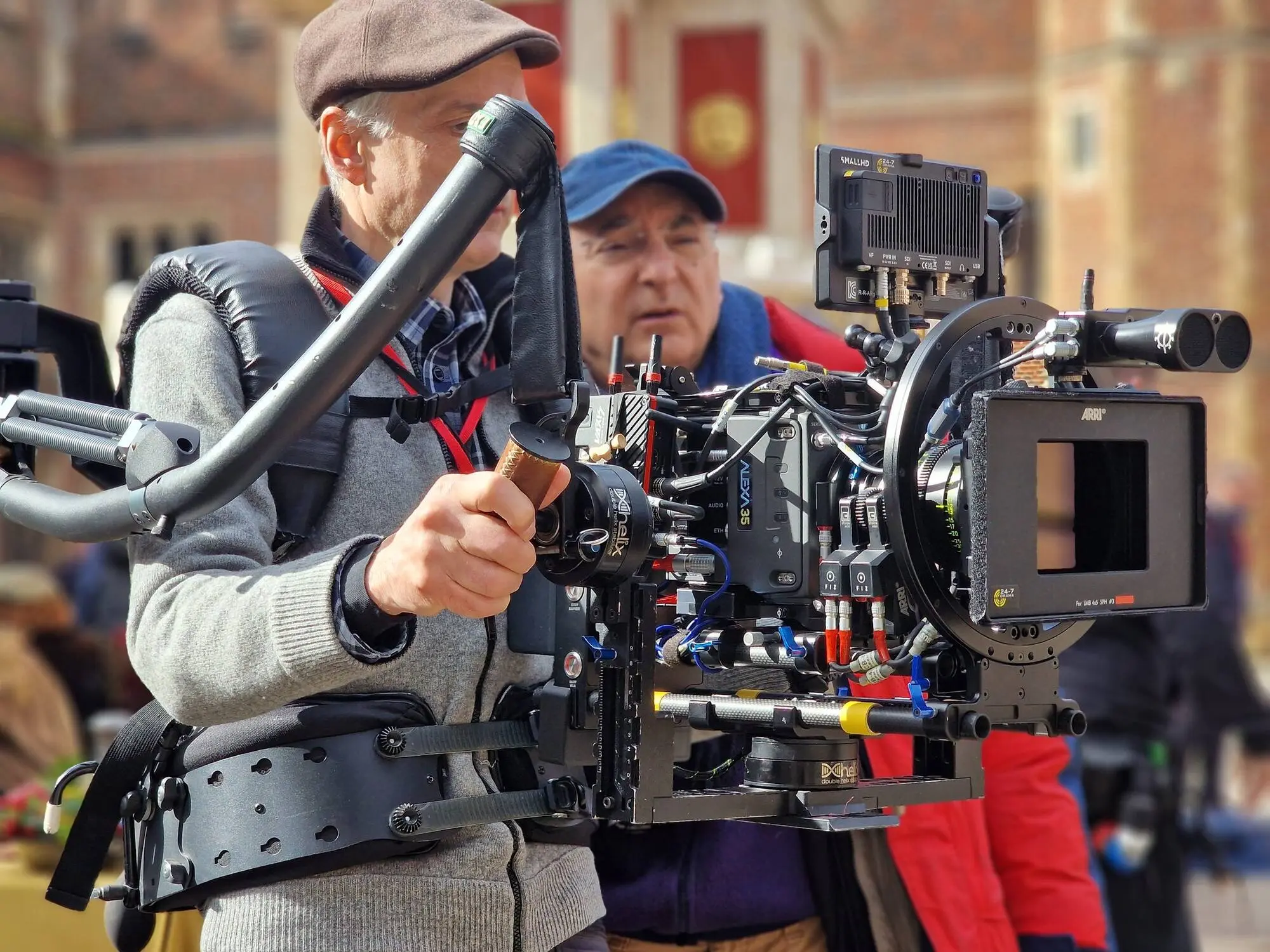
Camera car and crew lining up the next shot
Next
Knowing the words is not the same as hearing them at seven in the morning.
This list is free and it stays free. What it cannot do is put the language in front of you at speed, with kit in your hands and a schedule running. That is the Production Simulation Week: a crewed unit, prepped, shot and wrapped, with everybody holding a grade. The glossary is what you read before it.
Missing something
If a term is not here, it should be.
This list is written from UK sets and it grows when somebody tells us what confused them. There is no prize for already knowing the language, and no shame in asking — on set or here.