

Social value and procurement
Name us in your bid.
You are the prime. We are the delivery partner inside your tender, with a filed delivery record behind the wording.
A contractor bidding studio work, a training prime bidding a skills contract, a production company bidding a funded commission, a manufacturer answering a public-sector social value question: each needs a named, asset-locked partner that can run the activity, and evidence it afterwards. Quoted per contract.
What we deliver
What goes in your method statement.
Supervised trainee positions
Defined roles on a working unit, for defined dates, with a supervisor agreed in writing. 18 and over.
Technical training, delivered
Camera, lighting, grip, sound and production, on a working package, taught by working crew.
A standard you can adopt
The Faith Inclusion Toolkit and Charter, the Learn library and the directory are free to adopt.
Delivery outside London
Pinewood is the base, but the equipment and the crew travel. Units have run across England, Wales and Scotland.
Spend that reports itself
An asset lock commits what you spend here to community benefit, evidenced at Companies House.
PPN 026
Scored against the framework that takes over from 1 January 2027.
PPN 026 applies to procurements commenced on or after 1 January 2027 by central government departments, their executive agencies and non-departmental public bodies. It carries a minimum 10% weighting on contracts from £1m to £5m and a minimum 20% weighting above £5m, and the commitments are monitored through contractual KPIs.
It narrows social value to two outcomes — good jobs, and skills. The table below says which of the six criteria we deliver against directly, and which stay with you as the prime. We would rather tell you that now than have it found at evaluation.
| PPN 026 criterion | What we deliver against it |
|---|---|
| 1a. Create and/or retain high quality jobs | Partial. We place supervised trainees into defined roles on a working unit, for defined dates. The role sits on your production or your contract, so the job itself is yours to create; what we supply is the person, the supervision and the record. |
| 1b. Fair working conditions | Ours to evidence for our own delivery: a named supervisor agreed in writing before a placement starts, and a debrief afterwards. Conditions on the unit itself are the prime’s to answer. |
| 1c. Fair pay | This one is yours. We will not write a fair pay commitment into your method statement that we are not the employer for. |
| 2a. Training / retraining | Direct. Camera, lighting, grip, sound and production, taught by working crew on a working package rather than on equipment retired into a classroom. 286 participants trained through live production simulations, and 206 recorded attendances across 29 establishment-phase workshop days, in the year ending 28 January 2025. |
| 2b. In-work progression | Direct. 26 long-term trainees supported on structured pathways with mentoring in the same period, plus supervised positions on broadcast drama and feature productions with a named supervisor and a debrief. A placement nobody supervises is work experience with a better name. |
| 2c. Talent pipeline | Direct, and this is the strongest of the six for us. 4,000+ young people engaged through the Futures Festival and school and university outreach, and delivery into community, faith and regional settings that conventional outreach does not reach — London, Buckinghamshire, Sheffield, Leeds, Liverpool, Manchester, Lancashire, Farnham, North Wales, Aberdeen and Edinburgh. |
Figures are from our filed Social Impact Audit and Community Benefit Report for the year ending 28 January 2025, as submitted at Companies House, and carry the caveat set out below. Detailed PPN 026 evaluation guidance is due from Cabinet Office in autumn 2026; procurements commenced before 1 January 2027 may still be scored under the previous edition of the Social Value Model.
Local authority contracts more often use the National TOMs, which is broader than PPN 026. Tell us which one scores your bid and we will answer to that one.
The evidence behind the promise
Delivered, filed and counted.
A method statement is worth what the delivery record behind it is worth. These are the figures in our filed Social Impact Audit and Community Benefit Report for the year ending 28 January 2025, as submitted at Companies House.
They describe scale and delivery. They are not a claim that every figure is a unique beneficiary of Futures in Film CIC alone, and the filed report carries that caveat too.
286
participants trained through live production simulations
Filed report, year ending 28 January 2025
26
long-term trainees supported on structured pathways with mentoring
Filed report, year ending 28 January 2025
4,000+
young people engaged through the Futures Festival and school and university outreach
Filed report, year ending 28 January 2025
206
recorded attendances across 29 establishment-phase workshop days
Filed report, year ending 28 January 2025
What that looked like on the ground
Named work, in named places.
Social value is easier to score when the delivery is specific. Ours has been: drama and documentary production simulations with trainees holding real grades, placements on broadcast and feature productions, craft workshops, post-production blocks and public engagement — in London, Buckinghamshire, Sheffield, Leeds, Liverpool, Manchester, Lancashire, Farnham, North Wales, Aberdeen and Edinburgh.
Production simulations, run as productions
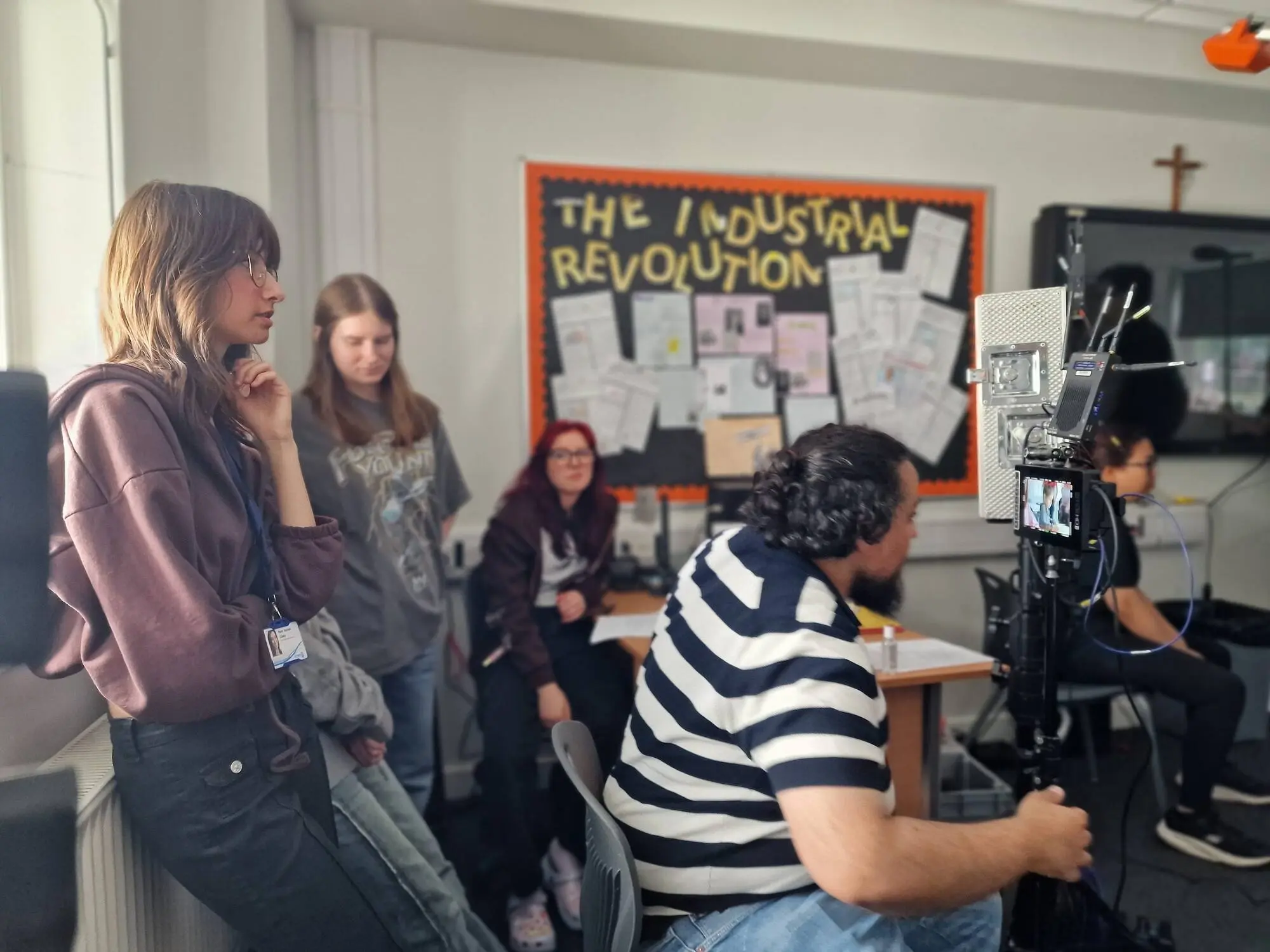
Full units with call sheets, grades and consequences — including a Liverpool drama shot in a working mosque during Ramadan with trainee crew, and drama blocks in Sheffield, Manchester and London. Participants leave with a credit and a practitioner who watched them work.
Placements on real productions
Supervised positions on broadcast drama and feature productions, with a named supervisor agreed in writing and a debrief afterwards. A placement that nobody supervises is work experience with a better name.
Reaching people the sector does not reach
Community, faith and regional settings that conventional outreach does not get into — mosque communities in Liverpool, Manchester and Aberdeen, schools and universities across the North West, and the Futures Festival at Pinewood.
A standard anyone can adopt, free
The Faith Inclusion Toolkit and Charter, the Learn library and the industry directory are published free and carry no charge and no membership. Adoption is the point; attribution is not required.
Wide festival floor: crowd, crane, LED wall
Due diligence
The facts your bid writer pastes in.
| Detail | Value |
|---|---|
| Legal name | FUTURES IN FILM C.I.C. |
| Company number | 14621615 |
| Incorporated | 27 January 2023 |
| Structure | Community interest company with an asset lock, registered in England and Wales |
| Registered office | 167–169 Great Portland Street, 5th Floor, London W1W 5PF |
| Operating base | the Ken Adam Building, Pinewood Studios, Iver Heath |
| Filed | Social Impact Audit and Community Benefit Report |
Policies and insurances on request. A policy without a board adoption date is a draft, and we show you which are which.
What we need
Four things, early.
- The tender or the lot, and the submission deadline.
- Which framework scores it — PPN 026, the National TOMs, the previous Social Value Model, or your own — and which questions we answer.
- The scale and the geography, so we can say yes or no honestly rather than late.
- The wording naming us, agreed in writing before it goes in.
Next
Name us in your bid.
Bring the deadline with you. If we cannot deliver what the lot needs, we say so rather than let it go in.