

The test rooms
Rooms on the lot where things get built, taken apart and found out.
The Ken Adam Building at Pinewood. Bench space, power and monitoring for technical work; light-tight rooms for handling film; secure storage and prep for packages going out and coming back.
They are working rooms before they are anything else. Our own courses, test days and productions run in them, and they are available around that.
What the rooms do
Four jobs, in the same building.
01
Bench and technical work
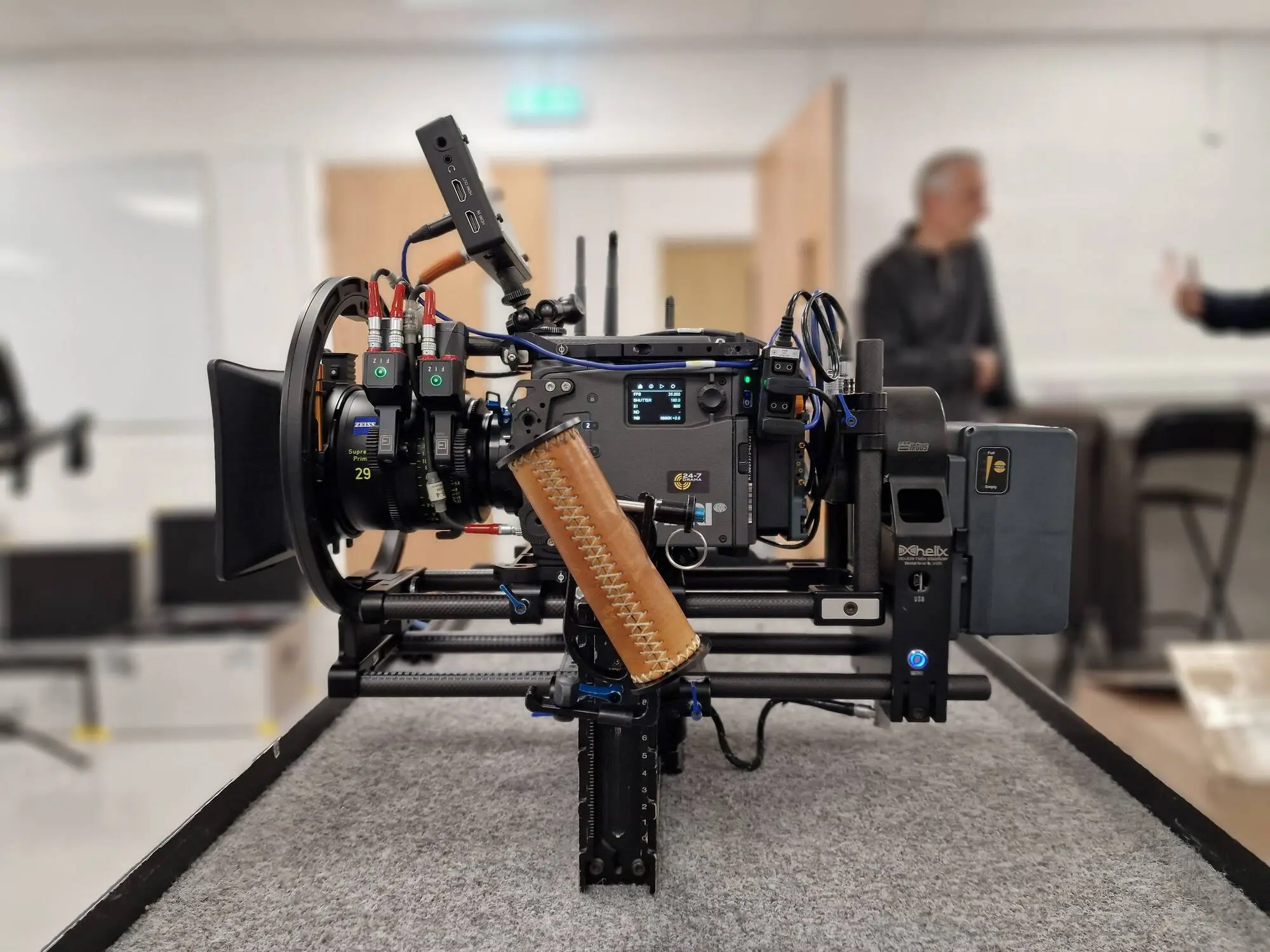
Build, teardown, repeat runs and controlled comparison. Power, monitoring and space to leave something rigged overnight.
02
Dark rooms for film
Light-tight rooms for loading, unloading and handling negative — the one thing that cannot be simulated.
03
Prep and secure storage
Where a package is prepped before it goes out, checked when it comes back, and held in between.
04
Teaching and supervision
Small-group technical teaching with the equipment in front of people, rather than a slide of it.
The dark rooms
A light-tight room is the scarcest thing in British film training.
Kodak sold more motion picture film in 2025 than in any year since 2014, and the demand is coming from independent features, commercials, music videos and student work rather than from studio tentpoles. The stock is not the constraint. The constraint is people who can handle it and somewhere to learn.
Film handling cannot be taught dry. It needs real stock, a real magazine, a real camera, a genuinely light-tight space and a lab at the end to close the loop. On a digital unit none of that exists, so the skill is never picked up in passing. On a film unit there is no margin to let an untrained person near the negative. Which is how a craft disappears while demand for it rises.
Facility
Rooms that are actually dark.
Light-tight rooms in the Ken Adam Building, for loading and unloading magazines, stock handling and the paperwork that goes with it. Changing bags and tents for work that has to happen away from a room.
Productions shooting on celluloid can book them. So can people learning to load, which is the harder thing to arrange.
Craft
The loader is the only person who touches the negative.
Between the manufacturer and the laboratory, one person handles the film: loading and unloading, labelling and the colour tape system, keeping the loading environment clean and light-tight, negative report sheets, daily stock reports, and carrying the lab’s rushes report back to the cinematographer.
It is a trusted grade with a short route in and almost nowhere to practise. We have the rooms, and we run the loop.
Research and development
Rooms you can book for work that is not a product yet.
A test room is a research instrument as much as a workshop. Controlled conditions, repeat runs, the same crew across a series of days, and a written record — the conditions a finding needs if anyone is going to act on it.
Technique development
Stabilisation, remote heads, rigging and wearable load support, developed across sessions rather than demonstrated once. What changes over a working day is the part a demonstration never shows.
Prototype and pre-production work
Hardware that is not finished, in a room with power, monitoring and people who will use it properly and say what broke. Under mutual confidentiality, agreed before anything arrives.
Workflow and pipeline testing
Colour pipelines, data handling, virtual production set-ups and AI tools in the production office and in post, tested department by department against the way the work is actually done.
Academic and funded research
Universities, funded programmes and industry bodies needing a working environment and practitioners rather than a lab. We can host the activity and evidence it.
Two operators handing over the rig between takes
On the same lot
What sits around the rooms.
Being based inside a working studio means the things a technical day needs are walking distance away rather than a logistics problem.
Stages and production facilities
Stages, workshops, production offices, wardrobe and hair and make-up rooms across the lot, bookable for the days a test or a simulation needs them.
Screening and review
Preview and post-production theatres on the lot, for viewing test material graded and at scale rather than on a monitor.
Film processing
A motion picture film laboratory operating on the same lot, which is why the film loop can be closed in a day rather than a week.
Studio conditions
Site access rules, security and the working discipline of a live lot. Visitors are booked in ahead; we pass the conditions on before you commit.
Next
Test in them, learn in them, or book them.
Tell us what you are doing in the room, how many people are in it and when. What is available depends on what is already booked, and we will tell you straight.